I found an old Vivitar lens at an estate sale for $30, then spent another $30 for an adapter ring so it will work on my Canon EOS T2i DSLR. The guys at B&H Photo in NYC say it’s German-made from the ’70s. Except for the butterfly, which is from the Bronx Botanical Garden, these are from our yard. I may have to try an insect series.
Old typewriter in Newtown, CT
Editor’s note: These seem from another universe given what happened in Newtown a couple of years later.
I’m just testing how the slideshow functions in WordPress, with some images I took at a historic house in Newtown, Ct. There is one of interest to journalists though — an old typewriter with an early version of the QWERTY key layout.
We’re 1 and 1 with Google Hangouts
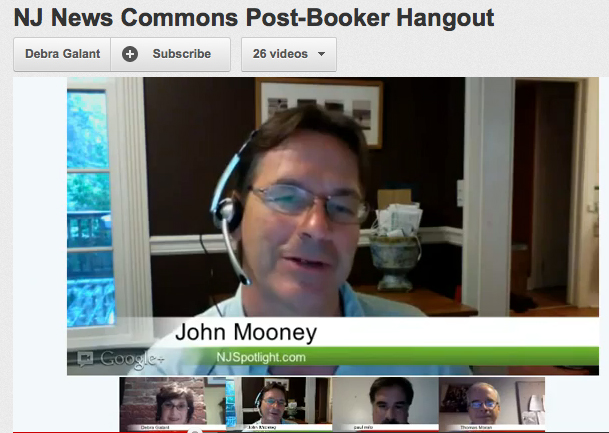
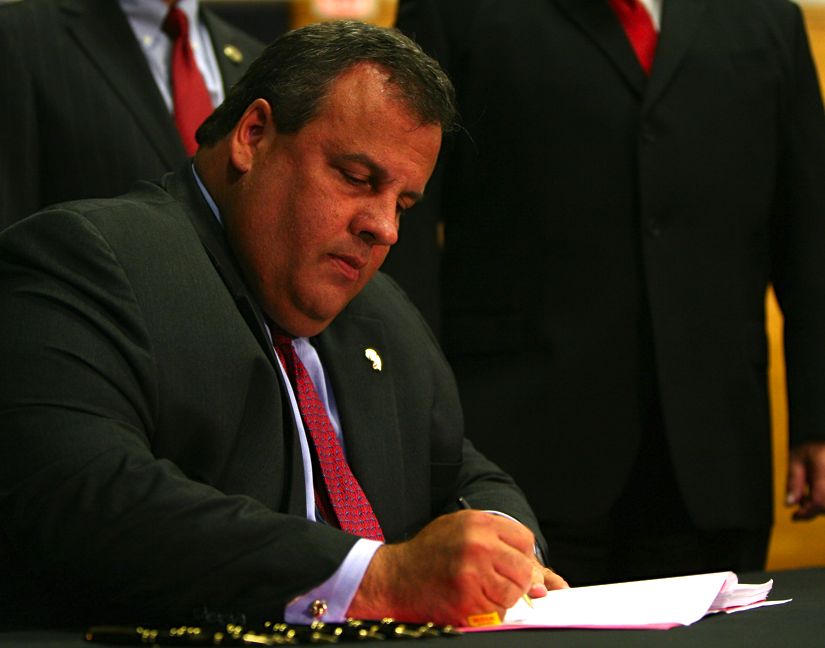
As I mentioned earlier, Deb Galant, who runs the New Jersey News Commons here at MSU, organized a Google Hangout Web video discussion after N.J. Gov. Chris Christie’s speech to the Republican National Convention last week.
We’d done a trial run the previous night and thought we’d ironed out all of the bugs, but the web can be fickle. One of our guests lost his connection and couldn’t join us and the n Deb lost HER connection halfway through our discussion. She was the host so when she dropped out, we lost the ability to stream, so we finished the discussion amongst ourselves. Here’s what streamed…
Still it was a good trial run. And the one she did a week later after Newark Mayor Cory Booker’s address to the Democrats went much more smoothly.
One big lesson learned:
Good lighting makes a huge difference. If you look at the demo videos Google posts or the ones from their booth at the GOP or Demo conventions, you can see how good the video quality is with good lighting (and better cameras). Hint to the folks at Griffin, or any wannabe tech startup — how about a cheap three camera lighting kit and some instructions on doing three-point lighting?
Join us for a video discussion after N.J. Gov. Christie’s Speech to the GOP convention
We’re testing out Google Hangout tonight for a video discussion here in New Jersey after Gov. Chris Christie’s speech to the GOP convention in Tampa.
If you’re not up on how that works, we’ll have 6 or 7 journalists from around the state all joining the live video chat, and we’ll stream it via YouTube. Then we’ll post a link to the video afterward.
Guests include:
-Yours truly.
– Debbie Galant, co-founder of BaristaNet and now director of the NJ News Commons, an initiative to strengthen journalism in New Jersey. Based at Montclair State, and funded by the Geraldine R. Dodge Foundation and the John S. and James L. Knight Foundation, the Commons seeks to foster cooperation and sharing between news organizations around the state.
– Ryan Dicovitsky, an adjunct professor of public speaking at Seton Hall University, and the head coach of Seton Hall’s Brownson Speech and Debate Team.
– Fred Tuccillo, the Patch senior regional editor for Central Jersey and the Shore, and a former national editor for Newsday, where he directed coverage of several conventions.
– John Celock, the state politics reporter and Patch liaison for The Huffington Post. He is based in Washington, and is the author of “The Next Generation: Young Elected Officials and Their Impact on American Politics.”
– Krystal Knapp, founder and editor of Planet Princeton, a hyperlocal site, and a former reporter for the Times of Trenton.
– Julie Winokur, documentary producer and the founder of Bring it to the Table, a Kickstarter-funded initiative to foster civility in political dialogue.
-John Mooney, a founding editor of NJ Spotlight and a veteran of both the Star Ledger and the Bergen Record.
Google Hangouts are still a bit primitive in terms of typical TV production standards, but with their ease of use, their cost (free!) and the ability to bring together people from around the globe who are interested in any particular topic, and stream their conversation so anyone else can listen in, they’re a huge new way to do “niche-casting.” And just maybe, Google will soon add some real producer tools.
Videos from International Symposium of Online Journalism
I did not attend the International Symposium on Online Journalism back in April in Austin, Texas, (nice place to be in April) but now the sponsors have posted videos from most of the presenters at the conference, and Nieman Journalism Lab has picked some of their favorites.
Ben Welsh of the L.A. Times tries to convince us all that it is not that hard to set up automated computer searches to parse data and he has some great examples of using that technique to automatically sort through real estate transactions or police blotters, at least for large cities such as Los Angeles. (It doesn’t work as well in those towns where the cops hand the reporter the handwritten log book to peruse in the chief’s office).
Brian Boyer of NPR makes the good point that too often flashy design trumps usability in interactive graphics (what’s wrong with on old-fashioned spreadsheet, he asks).
And University of Memphis j-school prof Carrie Brown-Smith shows how a local Twitter hashtag during a recent severe storm was useful to journalists.
Mapping with Meograph
Spent some time today with Meograph, a Web-based new software program that combines a multimedia timeline with a Google map. For now, it’s only available for users of the Chrome browser, but the developers promise it will be upgraded to work with other browsers.
What I like is its ease of use. Before you even sign up for the program, it invites you to create what it calls a “meograph”. But if you skip that step and go to their web site, there are several demos, including an excellent one done by a San Diego TV station on the Trayvon Martin case.
You start a Meograph by adding a Moment to a map. That might entail a date and location, e.g., the time when George Zimmerman first called police to report spotting Trayvon Martin walking through his neighborhood. The location is marked on a Google map, but then the program asks you to upload media, either photos or audio or video. The images are automatically sized and placed on the screen so they don’t obscure the map location. As you add more “moments”, more locations appear on the map. In the Trayvon Martin piece, e.g., there are the events of the night when Martin was killed, followed by statements from public officials, rallies protesting the death and court appearances for George Zimmerman. Yes, a video piece would have conveyed the material with more emotion, but it would have taken a lot longer to produce and the ease of making updates is a Meograph strength.
One very nice feature is that if you don’t have audio or video to upload, or if you upload a still image, you can click a button and record your own narration, using your computer’s built-in microphone or an external mic.
When you’re finished click Done and the “meograph” is ready for playback. It plays the presentation sequentially, highlighting each item on the map. If you later want to edit the content or to add additional media, no problem, just click on the Edit button.
There’s an Embed button, so it’s easy to add the content to an existing Web site, and links to send the Meograph to social media.
Meograph is also Web-based, so it is available on whatever computer you happen to have with you.
I want to play around more with the program, but it seems great for beginners, to get them to visualize a story in its separate components, with words and accompanying images. I think it would be useful as a sort of storyboard to block out a proposed piece, that might end up as a separate video.
But it’s also very good as a standalone timeline, particularly for stories that are going to be updated regularly. It would be very easy to use to plot crimes or accidents on the map and then use it to animate the data chronologically.
It is not as good at replacing video for some stories, as one of the Meograph demos on the Arab Spring and another on Whitney Houston’s life reveal. While the timeline is an excellent organizational tool for both, the requirement that the images pull back for each distinct Moment to reveal the map beneath is awkward where the map is not an integral part of the story. One important feature would allow producers to hide the map and just edit from one image or video to the next.
And, as always, if you don’t write to your media, the result is pretty boring. In the Arab Spring demo, e.g., the author makes little reference to geography, so the existence of the map as a background doesn’t add much at all to the story. A better writer would have used it to show the geographic scope of the turmoil taking place.
Old Books report, May 5
Lots of success today searching for old books at local estate sales and flea markets.
I spent last Sunday morning in Rome at the Porte Portese flea market, so it’s a little amusing that I had so much better luck in suburban New Jersey. But then, I don’t really know where to look for old books in Italy, other than expensive dealers.
We started out today at a huge community-wide rummage sale at the fairgrounds in Far Hills for the Visiting Nurse Association. The sale had begun on Thursday with advance purchases for folks willing to buy a ticket for $25, so I wasn’t that optimistic, but I found a 2 volume set of the French historian Charles Rollin‘s Ancient History for $20. It’s the 1870 “first complete American edition” from Harper Bros., much later than the 1807 version I already owned. No idea why they claim theirs is “complete” in 2 volumes, when the 1807 is 6 volumes, including several maps that are not in the later version. But still a handsome edition, even if the boards are detached on one volume.
Took a chance on Vol. 3 of a 3 volume set of Mrs. Mercy Warren‘s Rise, Progress and Termination of the American Revolution. I was not familiar with her work, but it was published in 1805, which is very early for anything on the American Revolution. Got home and checked ABEbooks and discovered that few copies are for sale. Volume 1 alone is going for $200, and the three volume set is only for sale one place, at $3,500. I paid $2 for Volume 3. Checked Wikipedia and discovered that she is the first female American historian, friend of Abigail Adams and Martha Washington, and Thomas Jefferson, and an ardent pamphleteer for the American cause.
Also bought a copy of the Universal Traveller by Charles Goodrich, from 1839, for $4, sort of an early Baedeker, though I’m not sure the author really expected anyone to use his advice while traveling, given how few folks actually travelled. Over 40 illustrations, though they’re crude woodblock prints and someone in the 173 years since the book was published has colorized about half of them, though very professionally.
I also indulged my love of anything illustrated by Rockwell Kent by picking up a copy of his version of Boccaccio’s Decameron for $2. Garden City Press, 1949, but NOT the 2 volume, limited edition, signed by Kent, that’s going for $300-$500 on ABEbooks.
Then on to Denville for an estate sale advertised as offering 2,000 books. Most of them turned out to be religious or cheap copies of classic stuff, but there were a few treasures. Got a copy of City of the Great King, by Dr. J. T. Barclay, 1858, for $10, which appears to be relatively rare. Six-eight engravings, two foldout illustrations, several more in color, plus several maps, all about Jerusalem. Plus the Cyclopedia of Anecdotes of Literature and the Fine Arts, a collection of anecdotes and amusing facts about authors and artists, published in 1867, also $10.
I wasn’t counting on finding anything at our final stop, in Linden, since the sale had been touted as having a lot of old sewing goods, which got Linda’s attention. But in the attic, in a cabinet above a huge box filled with knitting magazines from the 1930s and 1940s was a copy of Kiddle’s New Elementary Astronomy from 1870. Wonderful look at the state of knowledge at that time, and it was included in the $10 we paid for 110 knitting magazines.
So, $49 for eight books, only one less than 140 years old.