

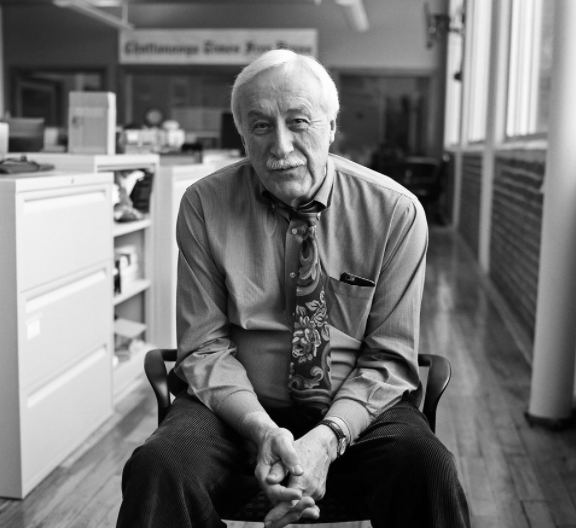

I’m a retired journalist who spent more than 50 years working in print, television and on the Web.
I’ve covered major trials for Court TV and managed the network’s O.J. SImpson trial coverage, written about national security for MSNBC.com, won awards for reporting on the nation’s energy crisis, covered health care… and helped AOL lose millions of dollars on a failed local news startup.
A journalism career is not always straight-forward.
I got my first byline in 1966, covering a local high school football game as a high school student working at the Chattanooga News-Free Press (despite the claims of local wags, the T-FP was not “news-free”).
I moved on to the Atlanta Constitution, where I began as the sole reporter working at the paper until 2 a.m. but eventually moved up to covering the state Public Service Commission and as a business reporter covered energy, international trade and what in those days was called “high tech.”
I left, perhaps foolishly, for a stint as press secretary for Georgia gubernatorial candidate Jack Watson (who had been President Carter’s cabinet secretary). Jack was a great candidate but we lost, the Constitution was merging with its afternoon rival the Atlanta Journal — and not hiring — and I ended up at WAGA-TV, the local CBS affiliate in those days, where I learned a lot about producing local television.
Fast forward three years, and I got a life-changing break. New York journalist Steven Brill bought the local daily legal newspaper and was looking for someone with both journalism and law experience to run it… and I was maybe the only reporter in Atlanta with those credentials. I went to the job interview in New York determined to demand a salary of at least $35,000, he offered $45,000 before I could ask, and I headed for Manhattan.
We had three reporters when we launched but I was a favored child because I had actually run a newspaper for Steven while the other two had not, so I ended up covering high profile trials such as the obscenity trial of the gallery owner who exhibited Robert Mapplethorpe’s nude photos, Jeffrey Dahmer’s insanity trial, the Rodney King police brutality case in Simi Valley, William Kennedy Smith’s date rape case in Florida and assorted hearings including those for convicted Atlanta child murderer Wayne Williams and Supreme Court Justice Clarence Thomas.
After two years of living largely in hotels across the U.S., Brill promoted me to executive producer for the network. We expanded our coverage to include a two-hour nightly trial wrap-up, plus a handful of shows including ones focusing on prisons and paroles, the Justice Department, the Supreme Court, and even a weekly program where we tried to explain legal issues to teenagers. We signed a contract with NBC’s Dateline to share our trial footage with them for what became their immensely successful one-hour crime programs. We spent 9 months covering the war crimes trials for Serbian leaders in The Hague. One of my proudest moments was our reconstruction of several hours of footage from the Nuremberg war crimes trials at the end of WWII, after we discovered that an audio tape existed of the entire months-long trial plus a few minutes of silent courtroom film from each day.
And then there was OJ. We’d had a premonition of what was to come a year earlier when we spent six months covering the trial of Eric and Lyle Menendez, accused of gunning down their wealthy parents in their L.A. home. We’d never covered anything that long, but almost every witness was compelling.
But the Simpson trial was another order of magnitude. As always, we were the pool camera, so we were constantly negotiating with other media, largely L.A. TV stations, as to what we would show (e.g., we refused to show the victims’ families’ faces when the prosecutor was showing photos of the bloodied bodies to the jury).
And yes, we screwed up and almost got cameras kicked out of the court when our cameraman, following prosecutor Marcia Clark’s pointer as she explained a series of photos to the jury, inadvertently showed the side of an alternate juror’s face for 1/2 a second. To our credit, we told the judge of our mistake and he allowed TV coverage to continue.
But after the SImpson verdict, Court TV was having difficulty getting cameras into courtrooms, and I was seduced by the Internet. A friend and Court TV colleague, Merrill Brown, was hired to run the joint Microsoft-NBC venture that included MSNBC, the cable news channel, and MSNBC.com, the news Web site, and he offered me a job.
I spent 10 years managing the NBC and MSNBC Web sites (Today, Dateline, Nightly News, Keith Olbermann, Don Imus, etc.), producing the site’s cover in the mornings, and writing stories on national security as a member of the special projects unit. Best story: One published the same week President George Bush declared “Mission Accomplished” in Iraq in which I quoted various experts predicting that things would collapse quickly, as they did.
After MSNBC.com, I moved to the Associated Press headquarters in New York, where I spent two years as deputy online editor and online editor.
From the AP, I moved to Patch, a startup where we tried to build a nationwide network of local news web sites. I launched and managed our first three sites and grew our network in New Jersey to 85 statewide, with an average monthly traffic of some two million unique visitors. But we never figured out how to make the sites profitable and after losing about $300 million, AOL sold the entire site to a hedge fund, which decimated the staff down to less than 100 staffers.
I moved on to Montclair State University , where I taught multimedia journalism for three years.
For family reasons, I moved home to Chattanooga, where I spent two years covering healthcare and city government for the Times-Free Press.
I have an undergraduate and law degree from Emory University, and a master’s degree in Urban Studies from Georgia State University.
When not teaching or blogging about journalism, I enjoy photography, playing guitar, double bass, or mandolin, and frequenting estate sales with my wife Linda.
 The Hudson Eclectic